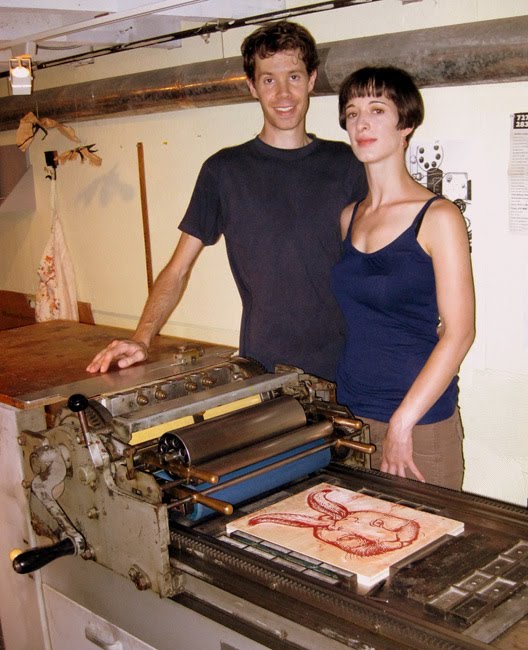
Tell us about yourself.
I’m a mid-west girl at heart. I was born outside of Minneapolis, Minnesota and for the first 5 years of my life I was surrounded by aunties, uncles, snow, and Sicilian food. We moved to Maryland when I was around 6 where I grew up in the suburbs of Columbia. The folks who designed the townships of Columbia created networks of trails that wound through patches of woods and contained creeks and ponds. It was in these woods that my fascination in plants began. I remember gathering moss, leaves, and small plants and making terrariums. In the summers my friends and I would play along the forest edges and pretend that we could communicate with the fairies that lived under the May Apples. My interest in mystical experiences found in nature and plants started in these suburban woods, but my interest in health started with a series of illnesses.
As a child I was always sick. I had asthma that would send me to the emergency rooms at least twice a year and I would find myself covered in rashes at the slightest touch of grass, cats, and tree pollen. At the age of 13, when nothing else seemed to work, my mom brought me to a Naturopath. He changed my diet, gave me herbs, and taught me how to breathe. In 6 months all of my symptoms were gone. This was the start of my journey in the world of natural health.

I attended college at University of NC – Asheville where I took my first yoga and meditation class. I was hooked. I found myself thirsting for more knowledge about Eastern Philosophy, ancient plant remedies, and yoga. During my years in Asheville I studied plants, worked on organic farms, practiced yoga, and started visualizing my professional future. My junior year in college was spent in Australia studying Aboriginal Culture, Myth, and Medicine and practicing yoga where ever I could find it. After graduating college, I set out in search of a clinical herbalism graduate program which I found in my own backyard; the Tai Sophia Institute in Laurel, Maryland. After completing my M.Sc in Clinical Herbal medicine in 2008, I began teaching yoga full-time, managed a yoga studio, and started building my herbal practice and my apothecary.
In January of 2012 along with friends and colleagues, we opened Sky House Yoga, a donation-based wellness collective that offers yoga, herbal medicine, astrology, acupuncture and educational workshops. It’s funny, I remember when I was 24 or 25 I had the realization that I would never be able to take a traditional career path. My interests were too eclectic and I needed a job that allowed space for creativity, study, self-expression, and one that honored the esoteric. When I entered into the fields of yoga and herbal medicine, I knew that it would not be easy, and that traditionally these fields brought a very modest pay. But here I am. I have no regrets and every day I am grateful that I am able to make a living doing what I love.
Describe the Sky House apothecary and your process for making the products you sell there.
The Sky House Apothecary is an herbal dispensary housing over 200 herbs in their raw form. We carry tinctures (alcohol based herbal extracts), dried herbs, powdered herbs, essential oils, and homeopathic blends. The Apothecary is mostly used for making customized formulas for herbal clients that we see at Sky House. We also have a range of pre-mixed herbal teas for sale. The formulas we have are based on what we see as common complaints or areas that most often need support. Our most popular tea, “Deep Green Healing Tea”, is a blend of nourishing and supportive herbs like Nettle, Holy Basil, Licorice, Elder Flowers, and Cinnamon Bark. “Deep Green Healing Tea” is high in minerals and is supportive to the adrenals, the immune system, and balances blood sugar. When I teach at retreats, this is the tea I bring and brew for groups. It is tasty, dark green, and everyone seems to benefit from the grounding and relaxing energy of the tea.
All of our herbs are 100% organic and blended by hand. We use recycled packaging and our labels were donated to us by a local graphic designer. All of our products have a donation range so people can pay what they can afford. In addition to teas we make our own White Sage smudging sticks which are great for clearing energy and cleansing spaces. We sell bags of Triphala powder for those with digestive issues and Kava powder for anxiety and relaxation. In the next few months we will be launching a line of tinctures for the fall cold/flu season.

Is there a spiritual component to your work?
There is absolutely a spiritual component to my work. Much of what I learned about plants and their healing properties has come from connecting to the more subtle energies of the plants. For example, you may have three plants that help with sleep, but one is heating, one is cooling, and one is specific for waking up at 2:00AM. The more we learn about these subtleties the better we can match a plant to a person. I see this as spiritual work. It is like trying to re-unite two friends and figuring out the correct timing, frequency, and environment.
I also think blending herbs opens us to connecting to the spirit of the plant and studying how they either work together, or in some cases DON’T work together! Blending herbs calls upon the deductive power of the rational mind yet does not limit us from using our intuitive centers. When these work together I think the medicine is at its most powerful.
In every tea you’ll see that the last ingredient is “love." I really think that creating a sacred space for blending the teas, and adding love, changes the tea. If the power of a thought can create an action in our own lives, I believe that adding some good vibes into our products has the potential to ripple more good vibes out into the world.
In addition to making herbal remedies, you also lead workshops that teach people about local plant life and how to make their own herbal remedies. Why is it important to you to share this art of making medicine with others?
We are all on this planet together and how we take care of ourselves directly impacts the world. The land we live on is rich and full of medicines that are gentle on our bodies and on the planet. When we learn about the plants that are growing in our local areas, like our front yards, we start to develop a kinship with them. In other words, having a relationship with something makes us want to get to know it and to protect it. It's a small way we can connect to and care for our planet.
Making plant medicines is a wonderful way to conserve our financial resources and cut down on transport and production costs. In the plant world, when we find a plant that contains a poison, we can often find a plant that carries the antidote growing nearby. For example, when we find poison ivy, within a few meters usually we can find its antidote, jewelweed. In the same way, many medicinal plants that grow near human places of habitat can be used to treat many of our western illnesses that come from over exposure to local pollutants and over consumption of processed foods. One great example is dandelion. We think of this as a pesky weed, but it is one of the best liver cleansers, detoxifiers, laxatives, and is a great source of potassium. I think all Americans would benefit by eating this local medicinal plant and I wonder if it is an accident that it grows all around us.

What are some of the greatest challenges you've encountered on your journey to building an independent business?
The greatest challenge was opening our doors and then having empty classes and treatment rooms. We had a wonderful grand opening with over seventy people yet when we opened our doors on the first day of business, no one here! Our first reaction was sheer panic. Did we do the right thing? Will anyone come? What next? Through patience, faith, and self-study, we looked at what we had in front of us and did our best.
It has been a continual learning experience. Some classes fill, others remain empty. Some herbal clients come back, others don’t. I‘ve learned that it is not just the structure of a business that makes it work, but the spirit of the business. Time and time again I see how the spirit of my offering affects the outcome more than strategy, which can sometimes even hurt the business. I don’t have a formal business background, so there may be things that I don’t see. Our business plan was probably weak, our capital was low, but our hopes and work ethic were high. We came up with a model that inspired us and utilized the strongest skills in each of us. We are now eight months into our first year and things are going really well. We continue to study the business like it is a garden, trying to predict its future needs. I would advise anyone interested in opening a small business to follow their heart, have someone to handle the books, watch your business like a small child, and give, give, give!!

Share something about yourself that most people don't know.
I am stubborn. Really stubborn. In astrology I am a sun and moon sign Taurus, and we are considered zodiacal “bulls in the mud”. Having two important planets in Taurus is a gift in many ways. Taurus is an earth sign and is ruled by the planet Venus, the planet that governs love, beauty, and material possessions. I have a pretty good eye for beauty and decoration; I can fix up old things and make them pretty. The earthy energy of Taurus is also what has attracted me to plants. Plants are pretty and valuable, two things that Taurus likes. My stubbornness is something I am constantly working on. I get really fixed on things and it takes me a really long time to let them go. In most cases I know better, but there is something inside that needs time, a lot of it, in order to process things. With plants, the good thing is that when I know a plant, my memory is strong and I will never forget something that I found to be true. The down side, is that it can take me hours to make a formula and if I am out of an herb I wanted to use, it can paralyze me. Haha, this is probably more than you wanted to know!!
Sky House Yoga offers yoga classes, astrology services, and herbal consultations. Join them on August 25 for a free class on Plant Essences, or, visit the studio for an Herbal Medicine Apprenticeship Program open house on September 23. For more information on herbal classes and workshops, visit the Sky House Yoga website or the Plants Whisper Yoga blog.