Showing posts with label featured crafter. Show all posts

Wednesday, August 15, 2012

love is an ingredient: interview with ashley litecky


Tell us about yourself.

I’m a mid-west girl at heart. I was born outside of Minneapolis, Minnesota and for the first 5 years of my life I was surrounded by aunties, uncles, snow, and Sicilian food. We moved to Maryland when I was around 6 where I grew up in the suburbs of Columbia. The folks who designed the townships of Columbia created networks of trails that wound through patches of woods and contained creeks and ponds. It was in these woods that my fascination in plants began. I remember gathering moss, leaves, and small plants and making terrariums. In the summers my friends and I would play along the forest edges and pretend that we could communicate with the fairies that lived under the May Apples. My interest in mystical experiences found in nature and plants started in these suburban woods, but my interest in health started with a series of illnesses.

As a child I was always sick. I had asthma that would send me to the emergency rooms at least twice a year and I would find myself covered in rashes at the slightest touch of grass, cats, and tree pollen. At the age of 13, when nothing else seemed to work, my mom brought me to a Naturopath. He changed my diet, gave me herbs, and taught me how to breathe. In 6 months all of my symptoms were gone. This was the start of my journey in the world of natural health.


I attended college at University of NC – Asheville where I took my first yoga and meditation class. I was hooked. I found myself thirsting for more knowledge about Eastern Philosophy, ancient plant remedies, and yoga. During my years in Asheville I studied plants, worked on organic farms, practiced yoga, and started visualizing my professional future. My junior year in college was spent in Australia studying Aboriginal Culture, Myth, and Medicine and practicing yoga where ever I could find it. After graduating college, I set out in search of a clinical herbalism graduate program which I found in my own backyard; the Tai Sophia Institute in Laurel, Maryland. After completing my M.Sc in Clinical Herbal medicine in 2008, I began teaching yoga full-time, managed a yoga studio, and started building my herbal practice and my apothecary.

In January of 2012 along with friends and colleagues, we opened Sky House Yoga, a donation-based wellness collective that offers yoga, herbal medicine, astrology, acupuncture and educational workshops. It’s funny, I remember when I was 24 or 25 I had the realization that I would never be able to take a traditional career path. My interests were too eclectic and I needed a job that allowed space for creativity, study, self-expression, and one that honored the esoteric. When I entered into the fields of yoga and herbal medicine, I knew that it would not be easy, and that traditionally these fields brought a very modest pay. But here I am. I have no regrets and every day I am grateful that I am able to make a living doing what I love.

Describe the Sky House apothecary and your process for making the products you sell there.

The Sky House Apothecary is an herbal dispensary housing over 200 herbs in their raw form. We carry tinctures (alcohol based herbal extracts), dried herbs, powdered herbs, essential oils, and homeopathic blends. The Apothecary is mostly used for making customized formulas for herbal clients that we see at Sky House. We also have a range of pre-mixed herbal teas for sale. The formulas we have are based on what we see as common complaints or areas that most often need support. Our most popular tea, “Deep Green Healing Tea”, is a blend of nourishing and supportive herbs like Nettle, Holy Basil, Licorice, Elder Flowers, and Cinnamon Bark. “Deep Green Healing Tea” is high in minerals and is supportive to the adrenals, the immune system, and balances blood sugar. When I teach at retreats, this is the tea I bring and brew for groups. It is tasty, dark green, and everyone seems to benefit from the grounding and relaxing energy of the tea.

All of our herbs are 100% organic and blended by hand. We use recycled packaging and our labels were donated to us by a local graphic designer. All of our products have a donation range so people can pay what they can afford. In addition to teas we make our own White Sage smudging sticks which are great for clearing energy and cleansing spaces. We sell bags of Triphala powder for those with digestive issues and Kava powder for anxiety and relaxation. In the next few months we will be launching a line of tinctures for the fall cold/flu season.


Is there a spiritual component to your work?

There is absolutely a spiritual component to my work. Much of what I learned about plants and their healing properties has come from connecting to the more subtle energies of the plants. For example, you may have three plants that help with sleep, but one is heating, one is cooling, and one is specific for waking up at 2:00AM. The more we learn about these subtleties the better we can match a plant to a person. I see this as spiritual work. It is like trying to re-unite two friends and figuring out the correct timing, frequency, and environment.

I also think blending herbs opens us to connecting to the spirit of the plant and studying how they either work together, or in some cases DON’T work together! Blending herbs calls upon the deductive power of the rational mind yet does not limit us from using our intuitive centers. When these work together I think the medicine is at its most powerful.

In every tea you’ll see that the last ingredient is “love." I really think that creating a sacred space for blending the teas, and adding love, changes the tea. If the power of a thought can create an action in our own lives, I believe that adding some good vibes into our products has the potential to ripple more good vibes out into the world.

In addition to making herbal remedies, you also lead workshops that teach people about local plant life and how to make their own herbal remedies. Why is it important to you to share this art of making medicine with others?

We are all on this planet together and how we take care of ourselves directly impacts the world. The land we live on is rich and full of medicines that are gentle on our bodies and on the planet. When we learn about the plants that are growing in our local areas, like our front yards, we start to develop a kinship with them. In other words, having a relationship with something makes us want to get to know it and to protect it. It's a small way we can connect to and care for our planet.

Making plant medicines is a wonderful way to conserve our financial resources and cut down on transport and production costs. In the plant world, when we find a plant that contains a poison, we can often find a plant that carries the antidote growing nearby. For example, when we find poison ivy, within a few meters usually we can find its antidote, jewelweed. In the same way, many medicinal plants that grow near human places of habitat can be used to treat many of our western illnesses that come from over exposure to local pollutants and over consumption of processed foods. One great example is dandelion. We think of this as a pesky weed, but it is one of the best liver cleansers, detoxifiers, laxatives, and is a great source of potassium. I think all Americans would benefit by eating this local medicinal plant and I wonder if it is an accident that it grows all around us.


What are some of the greatest challenges you've encountered on your journey to building an independent business?

The greatest challenge was opening our doors and then having empty classes and treatment rooms. We had a wonderful grand opening with over seventy people yet when we opened our doors on the first day of business, no one here! Our first reaction was sheer panic. Did we do the right thing? Will anyone come? What next?  Through patience, faith, and self-study, we looked at what we had in front of us and did our best.

It has been a continual learning experience. Some classes fill, others remain empty. Some herbal clients come back, others don’t. I‘ve learned that it is not just the structure of a business that makes it work, but the spirit of the business. Time and time again I see how the spirit of my offering affects the outcome more than strategy, which can sometimes even hurt the business. I don’t have a formal business background, so there may be things that I don’t see. Our business plan was probably weak, our capital was low, but our hopes and work ethic were high. We came up with a model that inspired us and utilized the strongest skills in each of us. We are now eight months into our first year and things are going really well. We continue to study the business like it is a garden, trying to predict its future needs. I would advise anyone interested in opening a small business to follow their heart, have someone to handle the books, watch your business like a small child, and give, give, give!!


Share something about yourself that most people don't know.

I am stubborn. Really stubborn. In astrology I am a sun and moon sign Taurus, and we are considered zodiacal “bulls in the mud”. Having two important planets in Taurus is a gift in many ways. Taurus is an earth sign and is ruled by the planet Venus, the planet that governs love, beauty, and material possessions. I have a pretty good eye for beauty and decoration; I can fix up old things and make them pretty. The earthy energy of Taurus is also what has attracted me to plants. Plants are pretty and valuable, two things that Taurus likes. My stubbornness is something I am constantly working on. I get really fixed on things and it takes me a really long time to let them go. In most cases I know better, but there is something inside that needs time, a lot of it, in order to process things. With plants, the good thing is that when I know a plant, my memory is strong and I will never forget something that I found to be true. The down side, is that it can take me hours to make a formula and if I am out of an herb I wanted to use, it can paralyze me. Haha, this is probably more than you wanted to know!!

Sky House Yoga offers yoga classes, astrology services, and herbal consultations. Join them on August 25 for a free class on Plant Essences, or, visit the studio for an Herbal Medicine Apprenticeship Program open house on September 23. For more information on herbal classes and workshops, visit the Sky House Yoga website or the Plants Whisper Yoga blog.

Sunday, July 29, 2012

featured crafter: sarah templin {radica textiles}


Tell us a little about your background and what inspired you to pursue textile design.

I started working with textiles way back in the day when, like many other high school girls, I experimented with altering thrift store clothes. That little taste of what textiles can do was enough to get me hooked on the sculptural possibilities that fabric lends: I started making a lot of clothes and sculptures out of fabric in college and for years afterwards. Ultimately, the allure of making the fabrics themselves won out over making things out of fabrics.


What materials do you prefer to use and why?

I learned how to screen print repeat designs on textile yardage, which is a slightly different technique that screen printing posters and t-shirts. You need to have a very long padded table to which your fabric is pinned. The screens are especially large and usually require two people who stand across the printing table from each other, passing the squeegee across the screen to each other in order to "pull the print." Every other spot is printed all the way down the table. When that ink is dry, you go back and fill in the blanks. The same process is repeated for each color of a design.


What is your process like?

When I design a new print, I most often work in the sunny third floor studio space of my row home with a brush and India ink or with a pen to create a drawing or motif. I then scan the image and manipulate it into a “repeat” form on my computer, meaning a textile motif that seems to repeat seamlessly along the yardage to create a uniform pattern.


What does Baltimore City offer that is particularly appealing to you as a working artist?

Baltimore is such a good city for people who like to forge their own way. Between the tight knit creative community, the affordable cost of living, and overwhelmingly supportive general population, I can’t believe my luck that I somewhat randomly moved here.

Visit Radica Textiles to learn more about products, custom orders, textile-related projects or for other general information.

Friday, December 30, 2011

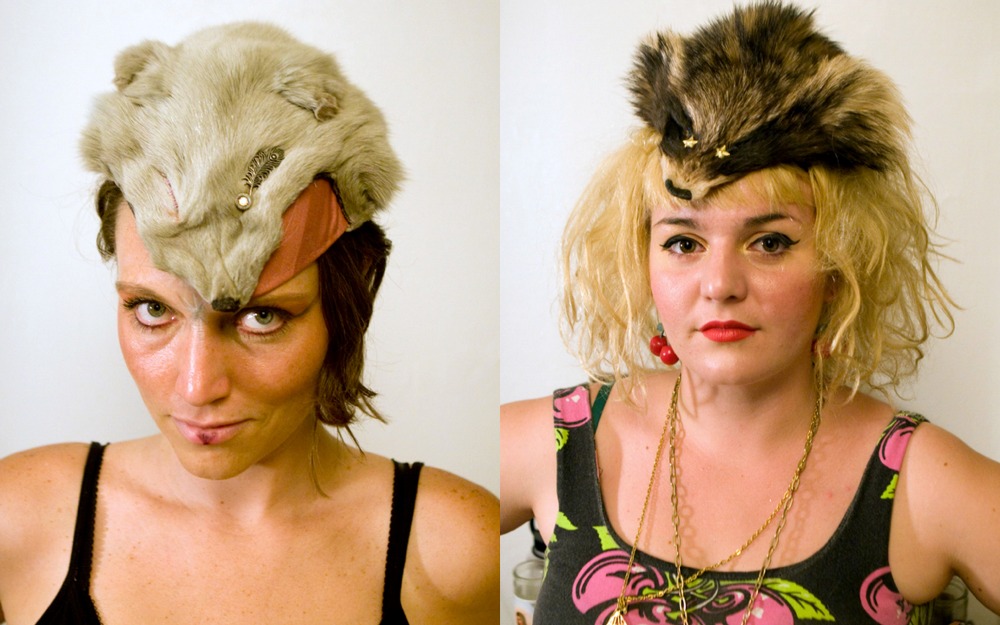
Featured Crafter: Kathryn Myers {Year of the Milliner}

Why did you choose to pursue hat making?

I have always been fascinated and a little in love with hats. "Hat" was one of my first words. Appropriately, "I'll do it myself was my first sentence." I have always spurned the current trend of ultra-casualness. Why are people wearing their PAJAMAS outside? Up until as late as the 1950's MOST people who were outside of their homes were wearing hats on their heads. I want to see this trend return. I believe that a large part of the unravelling of social interactions is that we don't try to look as though we are making an effort when we meet one another.

What materials do you prefer and why?

Well, my first hats were based around the idea of military garrison caps (AKA "cunt caps"). They are a beautiful and universal form. I would trick these out with all kinds of feathers and trinkets that I had been collecting since I was a teenager. Feathers and Vintage buttons. Veiling and chains.

Then I started to get REALLY into the dead animal stuff...I always had a fascination with the hides, bones and skulls of animals. I found a man who had faces and tails from various animals. I found a tooth dealer. This became my second style. I learned more about hat forms. Currently I am very into fox faces and buckram as the form. I love rhinestones and embroidery floss.

What is your process like?

It isn't always real easy. I spent 8 months traveling an epic journey to find a new home (from Oakland, CA) and a lot of my hats were made in the back of my '87 Subaru station wagon or in my gracious friends' living spaces. A lot of my process is in my head, trying to work it out before I actually use my resources. A lot of times I'll go to sleep with a hat obstacle in my mind and dream the answer. Weird, but true.

What do you hope to achieve with your work (professionally and personally)?

Well, originally I was just trying to make some hats to impress a girl. She was impressed and supportive. We don't talk now, but it got me going. Made me realize how passionate I was about all this. I just want to continue to make pieces that blow my mind; that I am proud to wear and see others wear. I want to to become better at my craft. Millinery is like taxidermy... real hard to find heroes, harder to find mentors. It's a lot of figuring your own game out.

What advice (if any) do you have for other aspiring artists/crafters?

Fuck DIY. DIT (do it together). I think we forget that this is how we keep craft alive. Learn from one another.

Do you consider yourself an "indie artist/crafter"? Why/why not?

Eh, i guess. That means "poor," right?

Are you originally from Baltimore?

Nah, but I love it here. It took a long time traveling to figure out this was the next spot that I would call home, and I am real glad I did.

Some little tidbit about you that most people don't know.

I'm a pretty nice, normal lady. You know, the whole bark vs. bite thing. Um, also I can fit my entire fist in my mouth.

Wanna see more? Visit Year of Milliner on Facebook.

Friday, October 1, 2010

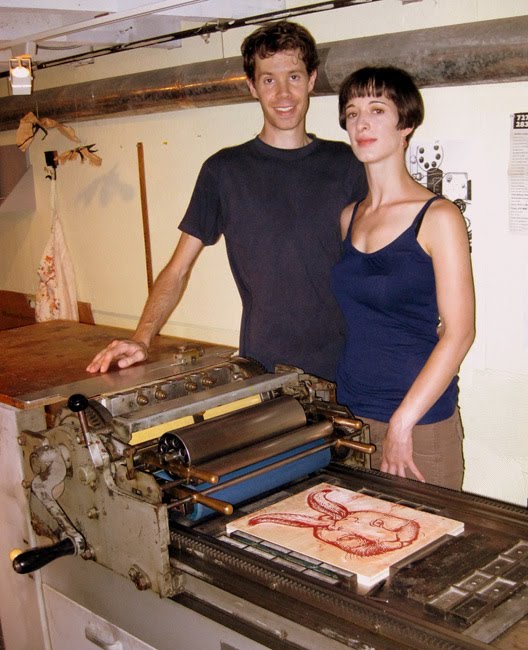
Featured Crafters: Ursula Minervini and Jon Poliszuk {Pellinore Press}


What led you to pursue design?

Ursula & Jon: We are always working toward earning a living creating art of some sort. With Pellinore Press, all aspects of production and distribution are under our control, which we find satisfying. This also impels us to hold ourselves to a higher standard of quality. We feel more a part of the world and our community by producing art that is made by hand but is still affordable.

What materials do you prefer and why?

Ursula & Jon: Our printing press is a 1957 Vandercook 15-21. We do letterpress printing from handset type and our own woodcuts.

The restrictions of working with the limited number of fonts in our collection of lead type, and the relative slowness of setting type by hand push us to be more attentive to our typesetting and design work.

One of our favorite woods to carve and print is cherry, for its crisp detail and the tactile pleasure in carving it. For larger prints we use shina plywood.

What is your process like?

Ursula: Working as a printmaker combines creativity, technical problem solving, and slow, careful, delightfully tedious craftsmanship. Some of our prints, such as the Exquisite Corpse Postcards and Exquisite Landscapes are created collaboratively. At other times we share the studio but work on independent projects.

Jon: I usually have a pretty clear idea of what I want any given piece to be. From there I’ll hone it with sketches until I feel comfortable enough to draw directly on the block. Since woodcuts tend to be very graphic, pencil is difficult to translate into carving, so I’ll use a brush and ink to finalize the image. When carving the block, I try to preserve the lively feel of the brush strokes.

What do you hope to achieve with your work (professionally and personally)?

Ursula: Professionally, we hope to continue selling our work directly through venues such as craft fairs and Etsy, as well as growing the number of independent retailers carrying our work. We hope Pellinore Press will develop a reputation for taking on unusual and challenging custom printing assignments.

Personally, it’s important to maintain the balance between work that is commercially viable and having the freedom to take artistic risks.

Jon: I hope to utilize the benefits and original purpose of printing (multiple copies produced fairly quickly and easily) to support causes I care about, by creating posters and the like.

What advice do you have for other aspiring designers?

Ursula: Write lots of to-do lists. I tend to feel better about working and to be more productive when I have a set schedule and know what my goals are.

Jon: Make sure your to-do lists are reasonable in terms of the time available, or it can be discouraging.

Do you consider yourselves independent artists?

Ursula & Jon: Not particularly. We’re working outside of today’s commercial mainstream, but at the same time our work has very traditional roots and draws on ideas and processes that are much older than we are.

Tell us some little tidbit about you that most people don't know.

Ursula: I abhor ladybugs.

Jon: I spend far too much time tinkering with my bicycle.

To read more about Pellinore, visit their website at www.pellinorepress.com or Etsy shop at www.etsy.com/shop/PellinorePress.

Monday, September 20, 2010

Featured Crafter: Ono Mangano {Sew Ono}

What led you to pursue design?

When I was starting college, a department chair asked me what I wanted to major in and I responded “phys ed” at which he looked me over, grinned, and said “no you don’t.” Since I was apparently really bad at hiding who I was I became an artist.

What materials do you prefer and why?

I will work with most textiles and found objects as long as they have all been pre-loved. My pieces are recycled right down to the buttons, trims and zippers. When I can obtain quality salvaged thread I will use it but mostly I buy that new, I don’t want a garment to fall apart on a customer because of dry-rotting thread. I have always preferred used materials. There is so much stuff out there and I believe we should be using all of our local resources to provide what we need.

What is your process like?

My process is very similar to what it was when I was a sculptor creating found object assemblages. I find used clothes or rickrack or buttons that appeal to me and I take them home and hope to fit them with other pieces that I have found. It’s amazing to discover that a new acquisition is the exact dye color of a vintage trim craft swapped the year before.

What do you hope to achieve with your work (professionally and personally)?

What I would most like to achieve is a common societal understanding and respect of the sustainable clothing movement. So many people are now coming on board to eat natural and buy local but their sustainable living doesn’t necessarily carry over into what they wear. No one is questioning why the standard mall chains are so cheap or care when the clothes fall apart. When that happens it is a new season anyway and time to buy the newest trends and pitch the old.

What advice would you give to other aspiring designers?

The best advice I can give is to make what you believe in. Don’t create based on fashion or social trends, you won’t be satisfied with what you make or yourself. Others will recognize and be more responsive to your passion and therefore your work.

Do you consider yourself an "indie designer"?

YES. I make recycled one-of-a-kind clothes from used out-of-style ones, by hand, in a studio/guest bedroom/office in my house. You won’t find the fashion industry lurking anywhere near me.

Tell us something that most people don't know about you.

Hmmmm, since Fall is upon us, I will admit to loving football and engaging in the highly unfashionable act of wearing a jersey, in public, on game day.

You can see more of Ono's work on her website or at Crafty Bastards on October 2nd, 2010.

All images courtesy of Ono Mangano.

Wednesday, September 15, 2010

Featured Crafter: Matt Muirhead

Describe your art and what led you to this particular medium.

I'm primarily a painter, but now that I'm screen printing (the last 3 years), I'm expanding into clothing, etc. It's nothing I can describe except that it's constantly evolving and expanding. As soon as I'm able to pin it down, it wriggles out of my definition. Painting seemed pretty intuitive for me, and when I looked at my future I couldn't see myself working for anybody else, so I thought, "Maybe I could tolerate being an artist in the long term."

What materials do you prefer and why?

I was a picture framer up until this past February. I make a lot of paintings on museum mat board. I get all the scraps I want from the place I used to work. It's great for printing on - so smooth. I also must admit to a bit of a paper fetish. I paint with acrylics, and I love ink and a dropper. I've also developed an addiction to spray paint and fluorescent pink paint. I also use Masonite (so smooth, gessoed with a squeegee). I use a squeegee to create a lot of the painting effects in my work. So much bandwidth in the striations. I build all my own screens in a friend's wood shop, as well as my own light box for exposing my screens.

What is your process like?

Chaotic. I work on a lot of pieces simultaneously. I have about 120 screens. The images are varied - old photographs, ads, blocks of text from old books, my own drawings, friends' poetry, and photographs I've taken. I have so many styles in my repertoire which I use to create whatever I want. I rely on a lot of accidents to take me in new directions.

I lay out maybe 20-30 boards and just start layering images and creating narratives within each piece. Now that I'm making clothing, I have a similar process - lay out all the articles I've decided to print on and begin placing images on them. They all come out unique and interesting, and if they don't, I just keep layering until something is happening. The result is a phenomenal output. The mixing of so many images gives me an exponentially increasing amount of possible paintings and design/narrative possibilities. It's so exciting to see an image I created a year ago be printed and read in the context of something I just made last night. I couldn't have intended the combination, yet there it is.

I spent a significant amount of time living in Tokyo, and just loved the freshness of the contextual blindness in the fashion's of Harajuku: "Let's dress in a traditional Victorian era gown and mix it with a Rolling Stones t-shirt." I love non sequitur. I love the absurd. I love that all the images I use have some sort of significance for me, whether a cultural affinity, or political/philosophical alignment. With them at my disposal, they become a language I can use to illustrate a multiplicity of ideas quickly.

Do you consider yourself an "indie" artist?

Yeah. Voted Best of Baltimore last year as the place to buy art, the self-representing artist is by definition independent. I think the proliferation of social media, and the grassrootsy zeitgeist of this moment in history means that it's never been easier to forge a path that avoids all the traditional venues for the thing I'm doing.

What advice would you give to other aspiring independent artists/crafters?

I don't know. I did what worked for me. I kept on working and making things and getting them out there. I've surrounded myself with loving and supportive people. The most dreaded phrase for me has got to be "You know what you should do." I've got an unorthodox approach. As a photography major in school, I took some basic painting classes, but am pretty much self-taught.

Share something about yourself that most people don't know.

I have a piece of sculpture in a park in China. It's a large, copper ship/Nautilus-shaped piece. I created it for an NGO in Japan that I was affiliated with. I built it in my kitchen, then, I got to go to China to unveil it. Pretty amazing experience.

Matt's gallery HEADSPACE is located at 720 W. 36th St. and is open Thursdays and Fridays, 4pm-8pm, Saturdays and Sundays, 2pm-9pm or by appointment. Call or text 443.791.6670 or email mattmuirhead@gmail.com.

You can also see current work at
Metta Integrative Wellness Center in Hampden (located above HEADSPACE), Joe Squared at North and Howard, The Rowhouse at 1400 Light St., and JOJOSouth Records at 2011 N. Charles St.

Finally, check out some of Matt's videography on his YouTube channel (be sure not to miss the short film To Warm the Bones - one of my personal favorites).

All images courtesy of Matt Muirhead.

Tuesday, September 7, 2010

Featured Crafter: Julie Bent {LOT201}

What led you to pursue clothing design?

I often see things that I like and think to myself "I could figure out how to make that." I am a natural problem solver and I love finding my own answers. Art is concept and execution, and I enjoy both challenges.

What is your process like?

People watching is my current muse. I love to see what kind of garments flatter the shape of people's bodies. Body shape is so unique from person to person, which is one challenge all clothing designers face. I am inspired by the interplay between garment and body and I pursue balance in all my designs.

From a more "nuts and bolts" perspective, my design process usually evolves from sketching ideas (both abstract and more technical drawings) to fabric sourcing. Once I find the perfect fabric, I begin building the garment much as an architect goes about designing a structure. A garment is developed on paper and tested in fabric. These fabric prototypes are marked for fit changes. These changes are then applied back to the paper pattern. The final paper pattern is graded out into different sizes and acts as a map that will eventually guide the garment through production.

What materials do you prefer to use?

I like to work with high quality cottons and silk...soft but crisp cotton holds its shape and still feels nice against the body. Silk is a really diverse material that creates a very distinct visual effect (color, reflection, texture, etc.). I like mixing different silks into one garment.

Do you consider yourself an "indie" artist?

Yes. Being independent from a team of designers, marketers, PR staff, and laborers means I do it all myself or find collaborators. Indie artists have no choice but to create their own opportunities.

For example, my fall collection - a collaboration with Form Boutique owner Aimee Bracken - started as an impromptu conversation about a private collection for Form. At the time, I didn't really know Aimee, but I admired her selection of garments at Form and thought that our pooled skills and resources could help our chances for success.

It turned out that an in-house line for Form was one of Aimee's original inspirations for opening the boutique. The garments that have resulted from our creative partnership are quite different than the garments I have designed solo, and I am excited to present our work to the public and especially to Form's established clientele.

What advice to you have for other aspiring independent designers?

There are definitely financial and logistical obstacles that I face as an independent designer. Therefore, working together with other people is important. I look for people who have the same standards for quality and attention to detail as myself. This way we won't have to manage each other.

The Form Clothing Label will debut on September 25th at the In Good Fashion Show Charity Event. To see more of Julie's designs, visit her website at www.LOT201.com.

Top image courtesy of
Bmore Media.

Thursday, September 2, 2010

Featured Crafter: Kacey Stafford {Found Studio}

What led you to pursue this particular craft?

Hmmmm...I think it chose me!! I've naturally been drawn to painting and designing since I was small. I've tried every type of media/crafting technique there is (almost) - and I kept coming back to painting. In college, I majored in Art Education which required me to take all types of art classes - printmaking, photography, ceramics, painting, sculpture. Each class enhanced my painting and gave me new ways of looking at and defining my process.

What materials do you use?

I prefer to work with paint and various collage materials. I love using vintage or discarded fabrics, papers, old letters, etc. Not only do I enjoy how these materials look, but it also feels good to know that I am re-purposing and re-using!!

Describe your process.

I am constantly looking for inspiration from nature, vintage items in antique/thrift stores, magazines - I love tearing out images that inspire me - I keep a notebook of them.

I work in layers. Normally, I start creating a textured collaged and painted background. On top of that collage I paint an image. I keep adding layers until it "feels right."

What do you hope to achieve with your work (professionally and personally)?

I hope to continue making work that inspires me and others. I'm thankful that I'm energized by my work; that it doesn't feel like a chore at this point. When it starts to feel like a chore, I will re-evaluate what I am doing!

Do you consider yourself an "indie artist"?

Yes, I am an "indie artist." I am my own designer, promoter, shipper, bookkeeper, etc. I must give my husband, Scott, some credit here. He often designs displays for me, helps me at shows, and is constantly coming up with clever and efficient suggestions. I have always had such a respect for "indie" artists. I smile to think that now I can consider myself one of them!!

What advice do you have for aspiring independent artists/crafters?

Don't be afraid to just START SOMEWHERE!!! Experiment and play with designs. Once you feel good about your product, then promote it...start and Etsy site, apply for a show. Remember, if you are not confident about your designs, no one else will be!! Be your own biggest fan and advocate. Also, set up a spreadsheet early and make it a habit of keeping up with your expenses...even if you only consider this a hobby. I am not always the best at this but it's the smart thing to do. You will be thankful to be organized come tax season AND this will help you know if you are making any money!

Share something that most people don't know about you.

I create silly things like ceramic bacon and mustaches because I love to see people's reactions to them!! They can make even the most somber customer smile and most folks downright giggle when they see them. It's always good for me to create something that is lighthearted and playful.

To see more work by Found Studio, visit Kacey's Etsy shop at www.foundstudio.etsy.com.

Wednesday, August 25, 2010

Featured Crafter: Hillery Sproatt

What led you to pursue crafting?

I always loved making things. I don't think it was so much a choice as it chose me. It seemed to be what I was best at.

What materials do you prefer and why?

I use mostly National Geographics from the 1950's-1980's when making collages. I think I prefer those years in part because of the imagery but also because the colors are so wonderful. The ink on the page is less saturated, it is more like hints of color. I also love to paint with gouache because it is very delicate.

I use lots of 100% natural linen, vintage cutting room scraps, and 100% wool felt that I order from Japan to make my embroidered objects. My mom is a woman's apparel designer; her company is called Rebe. I use lots of her fabric scraps as well to make my dolls and mobiles. She sources beautiful fabrics from all over the world. You can visit her site at www.myrebe.com.

What is your process like?

I am an intuitive maker. I don't often go into making with a plan. I try to look carefully at what I am making as I make it. I respond to what is happening in the work and go from there. I find it more fun that way and sometimes I end up somewhere I never imagined I'd be. I play.

What do you hope to achieve with your work (professionally and personally)?

I would love to have a store of found and handmade objects. It is my favorite dream. I hope to always be making things and support myself entirely by my handmade goods.

What advice do you have for other aspiring crafters?

Always be making even when it's not going well. Have fun. I often struggle with both of these things, but I've found that I make my favorite things when I remember them!

Do you consider yourself an "indie" crafter?

I am not sure I know what that means. I just think I am a maker of things.

Tell us something most people don't know about you.

I cry much too hard at movies - even the bad ones.


Visit Hillery's website at www.hilleryrs.com to read more about her work. She also has an Etsy shop and will be selling her work (along with her mother) at the Renegade Craft Fair in Chicago on September 11th-12th.

Images courtesy of Hillery Sproatt. Profile picture taken by Matthew Yake.

Tuesday, August 24, 2010

Featured Crafter: Jeffrey Everett {El Jefe Design}

What led you to pursue design?

I didn't really choose to become a designer or artist, I just kinda was. I can't really ever see doing something different. I can not play music, I am horrible with math and science, and besides building IKEA furniture, I am not technically inclined.

I did choose to be a designer instead of a "fine" artist and I am happy I did.

What materials do you prefer and why?

I use bond paper, my sketch book, and my swank Prismacolor Lead Holder to do all initial sketching before transferring it to the computer to finish it off, add type, etc. I am still using Adobe CS 3 - Illustrator mostly - to work the art to finish. I purchase all my fonts and so should you. I use French Paper because the quality is outstanding.

What is your process like?

For concert posters, I listen to the band a lot. I pick up lyrics and imagery to get inspired on what to draw. Little details and references go a long way to appeal to fans and make the posters mean more to buyers. People can tell if you don't know the music.

Some bands, like The Gaslight Anthem, are rich with poetry and make it easy to draw out imagery to use. Other bands are more about feelings and intent so you have to do more interpreting. Neither way is better though I will say I have around 100+ unused sketches for Gaslight Anthem that may never be made into a final product.

What do you hope to achieve with your work (professionally and personally)?

I would like to eventually support myself full-time by doing posters and illustration. Right now, I do fun things like logos, websites, and other things to help pay the bills, which isn't bad but there is nothing like doing large scale illustration for people you respect.

Do you consider yourself an "indie" artist?

I do. Mainly because I fell I work outside of the "fine" art world (though my work has occasionally been shown in galleries) and my work is not seen as important as "real" design jobs like annual reports and logos (though my work has been shown in many design magazines and books). What I do, i feel, straddles the line between "art" and "design" and thus is neither. Some people feel concert posters are about advertising the band, while others will buy a poster regardless of who it is for - they just like the art.

I get a lot of "that would be fun to do" by designers and artists who don't know how hard it is to do this.

What advice would you give to other aspiring artists/designers?

Learn how to talk about your work and don't be shy. Don't wait for people to give you assignments - be your own client - create things to do. Get a lawyer and accountant to help you build and protect your business. Pay your taxes!


Tell us something that most people don't know about you.

My son Max can draw better than me.

Visit El Jefe Design to learn more or purchase work. Jeffrey has posters for The Bouncing Souls, The Budos Band, New Medicine, Wovenhand, and The Gaslight Anthem coming out soon. Stay in touch and sign up for his e-newsletter at http://www.eljefedesign.com/ or become a fan on Facebook. You can also check out the El Jefe Design Etsy shop to purchase his new line of tees, or visit him in person at Crafty Bastards in Washington D.C. on October 2nd.

Monday, August 23, 2010

Featured Crafter: Elizabeth Voss {Raw Olive}


What led you to this particular craft?

Raw Olive was born out of a desire to find pure, natural body products for my family. I was shocked to learn that a lot of the "natural" products offered at health food stores still included potentially harmful ingredients such as parabens, sodium laurel sulfate, and petroleum. I started experimenting in my kitchen with natural ingredients that were already in my cabinets such as cold-pressed olive oil, raw sugar and raw honey, to name a few. Soon enough, friends and family were hooked on some of our yummy creations.

Raw Olive has become a perfect marriage between my love for cooking and all things natural.

What is your process like?

The creative process is what I enjoy most. With three girls, 7, 9, and 12, I am constantly trying to create products that I feel comfortable with them using. Once I have an idea, I experiment in the kitchen until I am happy with the final product. Once complete, I test the new product on my family and audacious friends and hope it's a hit.

What do hope to achieve with your work (professionally and personally)?

With Raw Olive, I am devoted to educating people about the dangers of chemical-laden body products and providing a pure, natural alternative. I strive to provide products with as many food-grade and organic ingredients as possible. My mission is to create handcrafted, natural body products that are safe for the consumer and the environment. If I do this, I have succeeded both professionally and personally.

What advice do you have for other aspiring crafters?

Do what you love and offer a quality product. Whatever you are trying to sell has a little piece of you in it, so you need to be proud of your products. I'm also a big fan of Etsy. I started
my shop a few months ago and absolutely love the forum for selling. Etsy crafters are incredibly creative and inspiring.

Do you consider yourself an "indie crafter"?

I am totally an indie crafter. I love the freedom of owning my own business and having total control from beginning to end. Sadly enough, the corporate giants have compromised their quality with cheap, and potentially dangerous ingredients in order to greedily make money. I don't subscribe to that. We need more environmentally and socially responsible companies to step forward and lead the beauty industry.

Tell us something that not many people know about you.

I sometimes race mountain bikes and don't like to lose!